

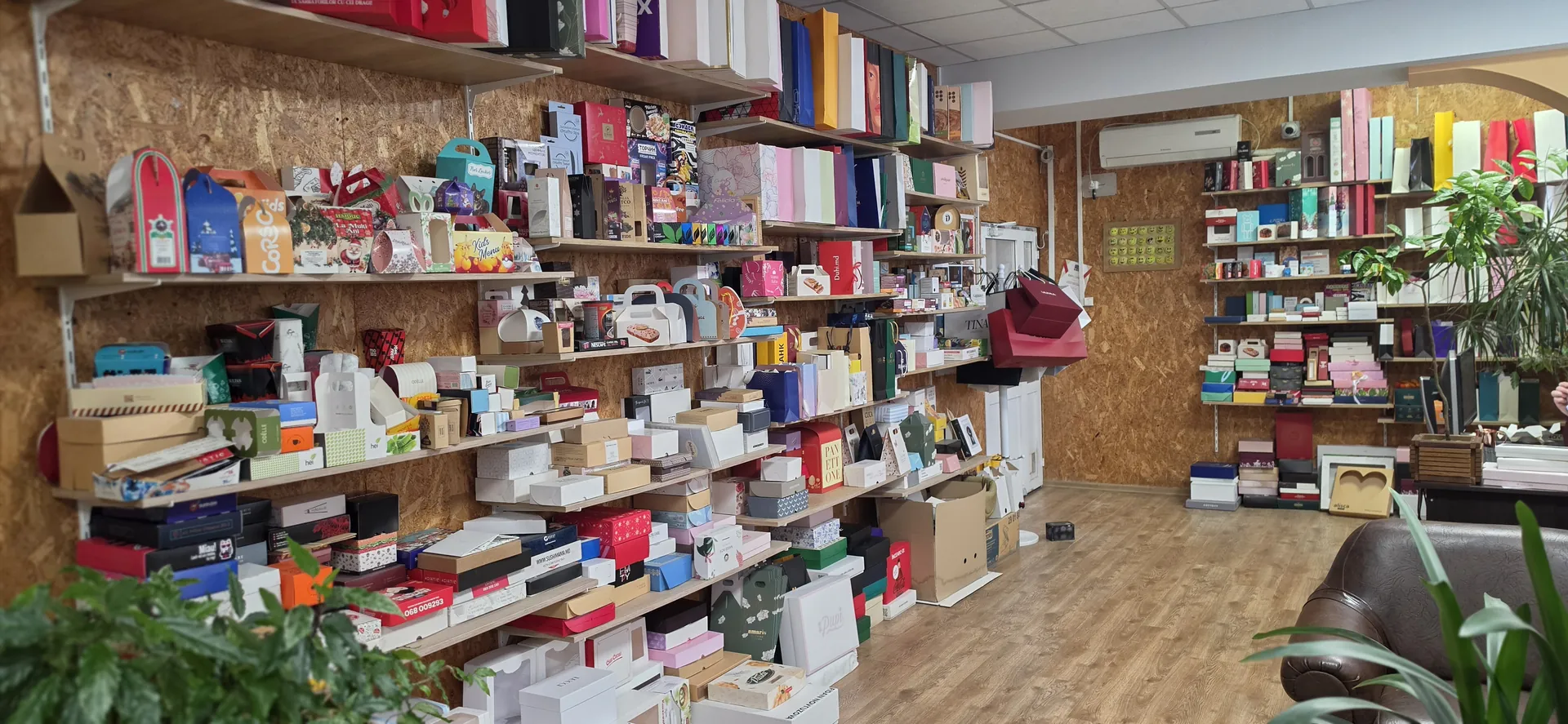
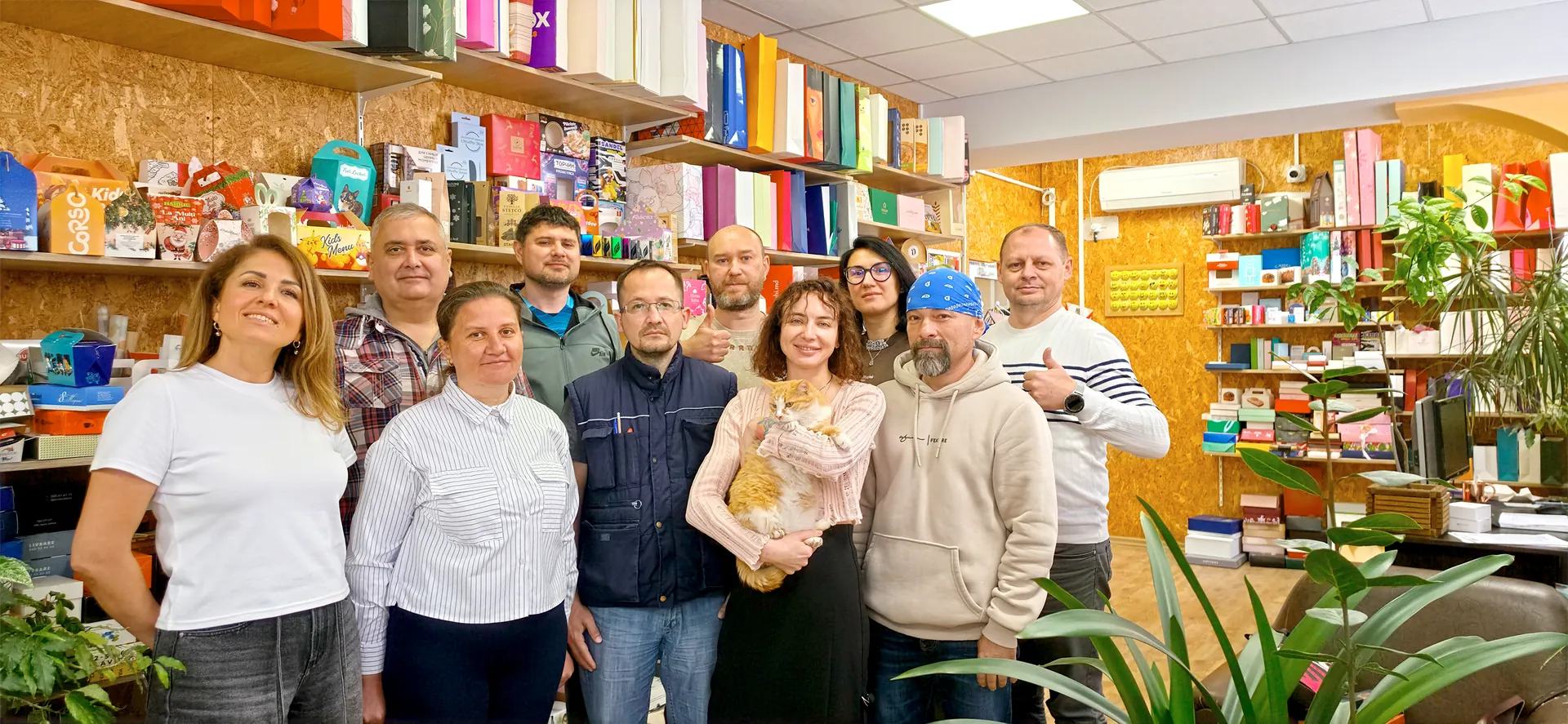
Pergament is a full-cycle cardboard packaging factory in Chisinau: 27 years on the market, a team of 40 specialists, 3,000 m² of production and warehouse space, and direct import of materials from European and Asian manufacturers. Below is how your order moves through the production chain — and which of our machines are the only ones of their kind in Moldova.
In 2026 we carried out the biggest expansion in the company’s history: in April we bought a production and warehouse complex on the outskirts of Chișinău — 2,000 m² of buildings and 6,700 m² of paved yard space. It houses warehouses for raw materials and finished goods — we store print runs and ship them in batches on each client’s schedule — plus an office and showroom and halls for new product lines. The team has grown from 20 to 40 specialists. The machine park gained a gluing plotter (hot-melt and cold glue) for runs of up to 1,000 boxes and constructions that cannot be glued automatically, a full-servo window patching machine and a matched pair for the food line: a paperboard bowl forming machine and a lid thermoforming machine. The bowl and its lid come off a matched pair of machines, so the geometry fits perfectly and nothing leaks — our answer to the single-use plastics Moldova is phasing out.
Design and prototyping
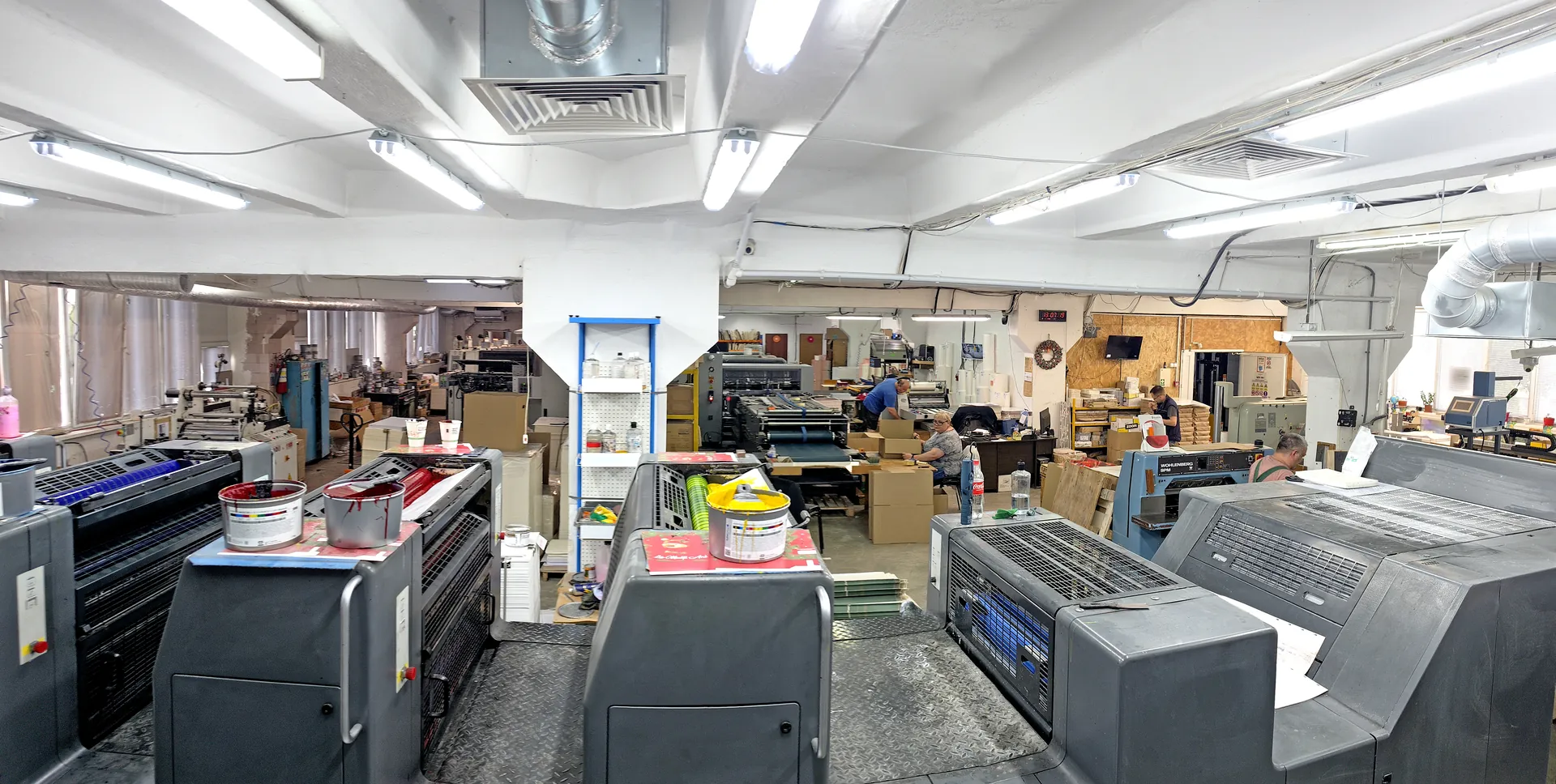
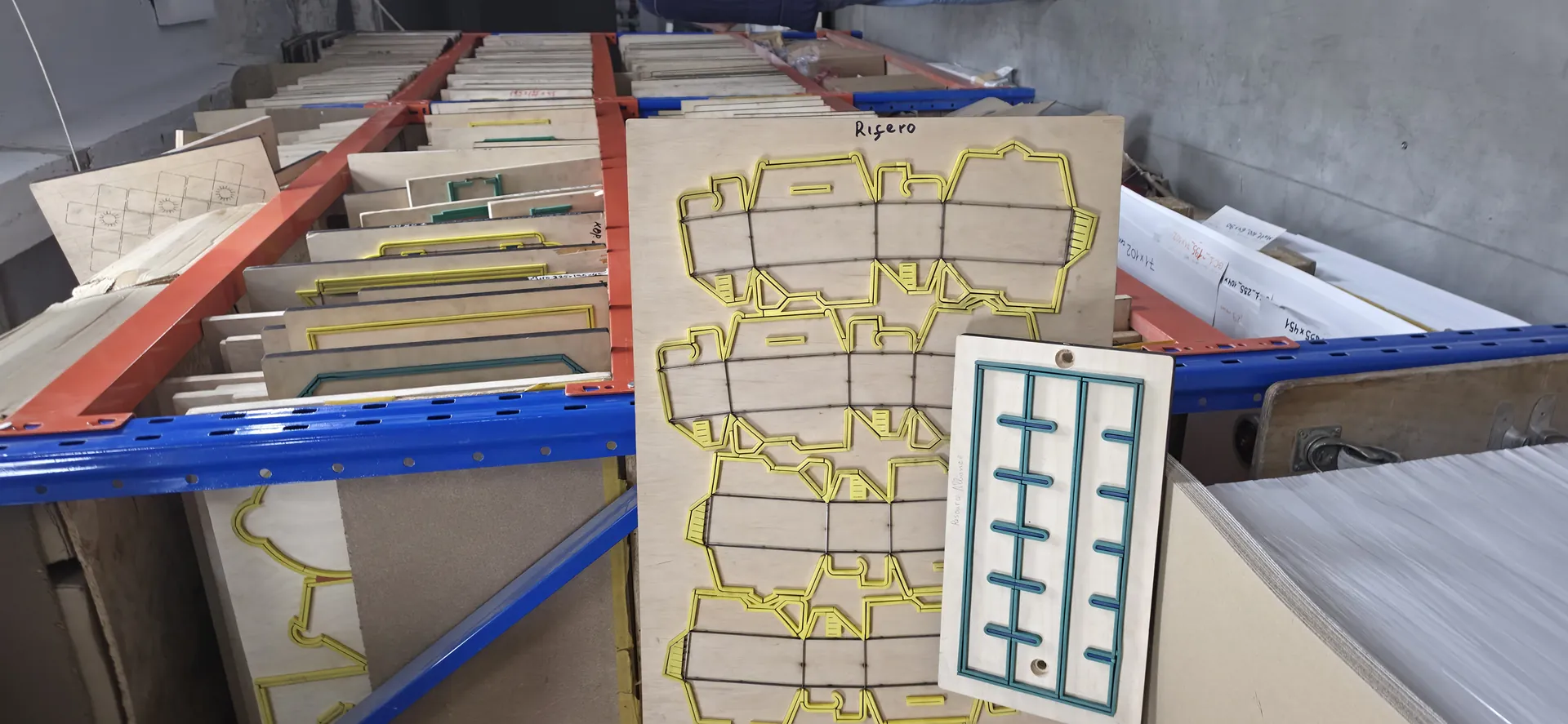
Every box starts in a CAD system: the engineer builds a dieline with precise geometry, drawing on a library of 3,000+ ready-made cutting dies (which saves the cost of a new die) or developing a fully custom construction. A physical prototype is cut on the plotter from 30 minutes, and a colour test mini-run can be printed in the digital department — see Box prototype from 30 minutes.
Printing: heavy-class offset and press-class digital
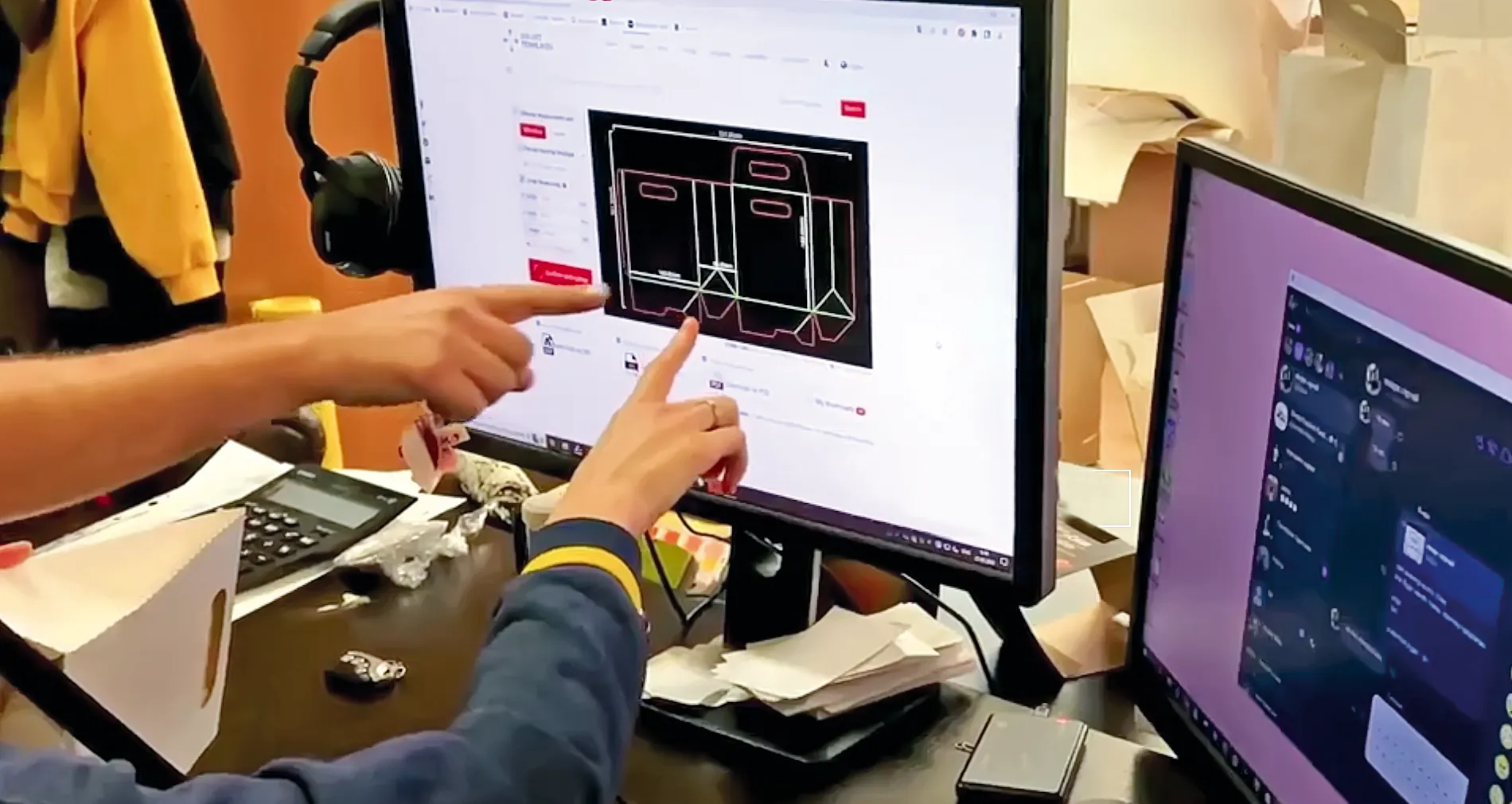
Large runs are printed on two German heavy-class offset presses built for cardboard — a Heidelberg with an in-line coating unit (printing and coating in a single pass) and a Manroland. Two presses mean reserved capacity: your deadline does not depend on a single machine. Small and pilot runs are printed in the press-class Konica Minolta digital department with quality close to offset.
Cutting and lamination
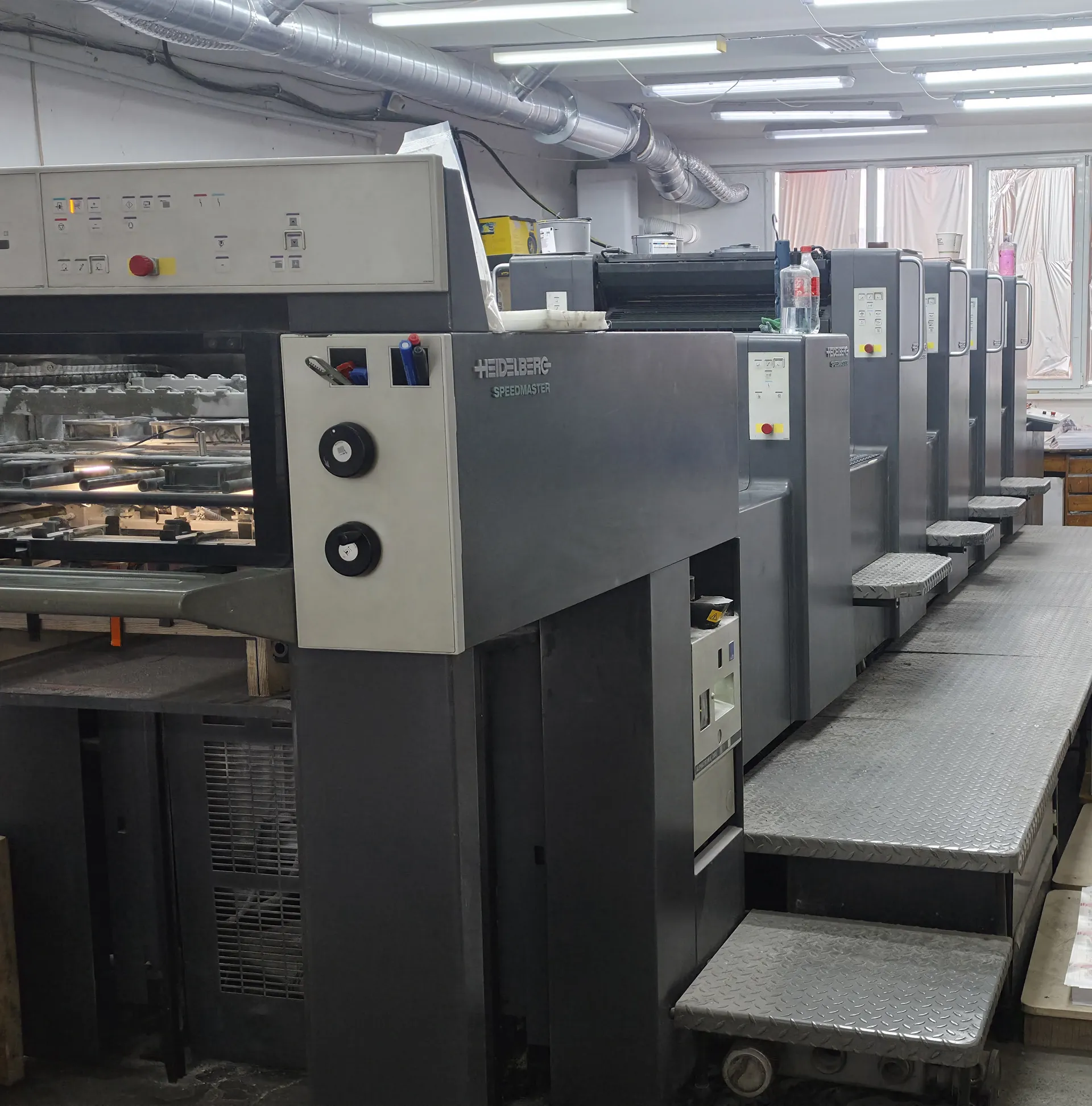
Three German guillotines (Polar 115 and two Wohlenberg 76) and four laminators, including a high-speed heavy-class automatic and a double-sided one, keep large orders moving without bottlenecks.
Finishing
Die-cutting on Bobst equipment, fully automated Heidelberg hot foil stamping and automatic spot UV coating with UV drying: premium finishing here is a production line, not a manual operation, so it is available on mid-size and large runs without extending deadlines.
Folding and gluing: the only servo-driven line in Moldova
Our new folder-gluer handles 1 to 6 gluing points, hot and cold glue and pre-fold, with every belt on servo drives. It is the only machine of its class in Moldova and one of the best in Eastern Europe. For you this means two things: complex constructions such as crash-lock bottom boxes are produced in series rather than by hand, and the geometry of every box in the run is identical — exactly what automatic filling lines require. A second three-point folder-gluer handles simple fast runs in parallel.
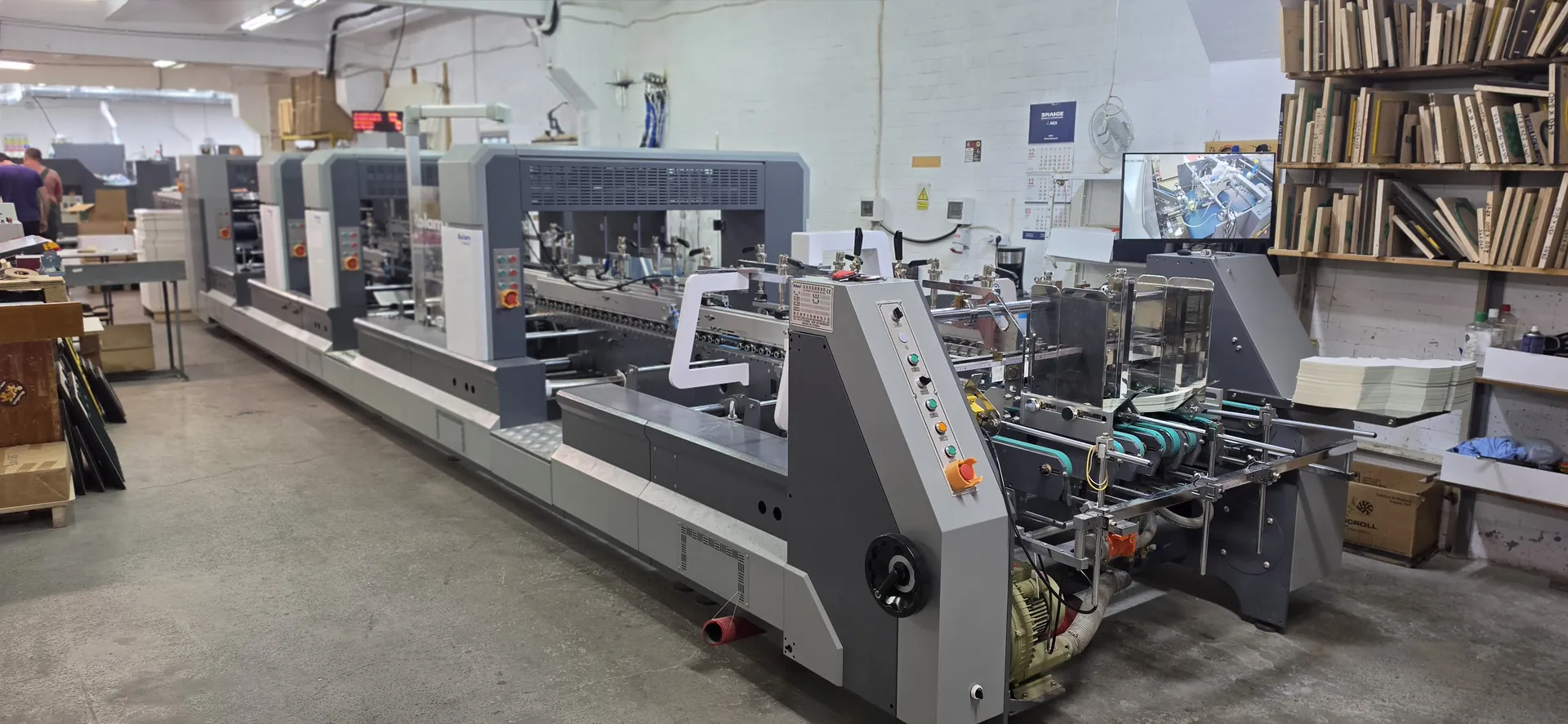
Window patching: 10,000 boxes per hour
Transparent windows are applied on a fully automatic line — the only one in Moldova — at up to 10,000 boxes per hour. A window makes the product visible on the shelf and, thanks to full automation, adds almost nothing to the cost or the production time of the run.
Rigid box assembly line
Premium lid-and-base boxes made of rigid board are assembled on an automatic line. Elsewhere such boxes are usually assembled by hand; automation gives serial runs the quality of a hand-crafted piece with predictable deadlines.
Digital order management: the first MIS-run printing house in Moldova — since 2014
From the first enquiry to the last shipment, every Pergament order lives in a production management information system — PSystem MIS. Not in a manager’s notebook, not in e-mail, not in someone’s memory. We were the first printing house in Moldova to move to such a system — in 2014; more than 36,000 orders have gone through it since, and every one of them is still on file. For the customer this means seven concrete things:
- A price in minutes, not days — and in variants at once. The calculation is operation by operation: board, print, finishing, die-cutting, gluing, packing — each with time and consumption norms. In one reply you get exact figures for 2–3 variants: a different run length, a different board, with or without lamination, with or without a window.
- A job ticket specified down to the smallest detail. Board grade and weight, print sequence and inks, die number, varnish, gluing scheme, packing method — all fixed in the order’s tech passport before the job reaches the shop floor. The shop floor executes a document rather than “remembering how it was done last time” — no mix-ups in production.
- Your full order history — since 2014. A repeat run a month or ten years later is printed from the same passport: the same board, the same inks, the same die. Your manager changed, ours changed — the order does not suffer.
- A real deadline, not a promise. Scheduling starts from the actual load of each machine and the order queue: behind the date we give you is a slot on a specific press and a specific folder-gluer.
- The order moves through the plant on its own — and you always know where it is. After payment nothing needs “pushing”: 9 shop-floor terminals at key points show people in every zone what to do and in what sequence. Every operation is registered in real time, so when you ask “where is my order”, the manager answers from the system, not by calling the shop floor.
- A correct warehouse. Materials are reserved for the order automatically, finished goods are booked into stock when the last operation is completed, batch shipments are tracked with an exact balance: order 10,000 boxes at a large-run price, collect 500 a month — you can see at any time how many are left and when they shipped.
- Correct, fast invoices and delivery notes. The contract, invoice and delivery note are generated from the same calculation the price came from. No discrepancies between quote and invoice, no item errors, no “accounting will issue it tomorrow”.
Order inside means quality outside: costs are calculated plan vs. actual per operation, waste and rework are visible immediately, machine load is transparent. We know our economics down to the operation — which is why repeat runs get an honest price.
Frequently asked questions
Can I see the box before the run starts? Yes. A prototype is cut on the plotter from 30 minutes, and if needed we print a colour test mini-run in the digital department — the sample is as close as possible to the production item.
Are window boxes possible on large runs? Yes. The automatic window-patching line runs at up to 10,000 boxes per hour, so a window has almost no effect on the production time.
Can you repeat our previous run exactly? Yes. The tech passport of every order has been stored in PSystem since 2014 — board, inks, die, finishing, gluing. A repeat run is made from it, not from memory.
How fast do you quote? The operation-by-operation calculation takes minutes. One reply gives you 2–3 variants — by run length, board or finishing — so you decide on figures.
What if our manager changes — or yours? Nothing changes. Order history, tech passports, prices and notes have been kept in the system since 2014, not in one person’s head.
How do I know what stage my order is at? Operations are registered on shop-floor terminals in real time. Call or write to your manager — they see the stage in the system without calling the shop floor.
Do you assemble complex constructions by hand or in series? In series. The servo-driven folder-gluer with 1–6 gluing points and pre-fold assembles complex constructions, including crash-lock bottoms, automatically.
Visit the production floor
Call +373 790 444 17 (Viber, Telegram) or write to contact@pergament.md — we will show you the machines at work, and a prototype of your own box takes from 30 minutes.
Food packaging: the board and inks we print with are approved for food contact — the ANSP approval and laboratory test results.