

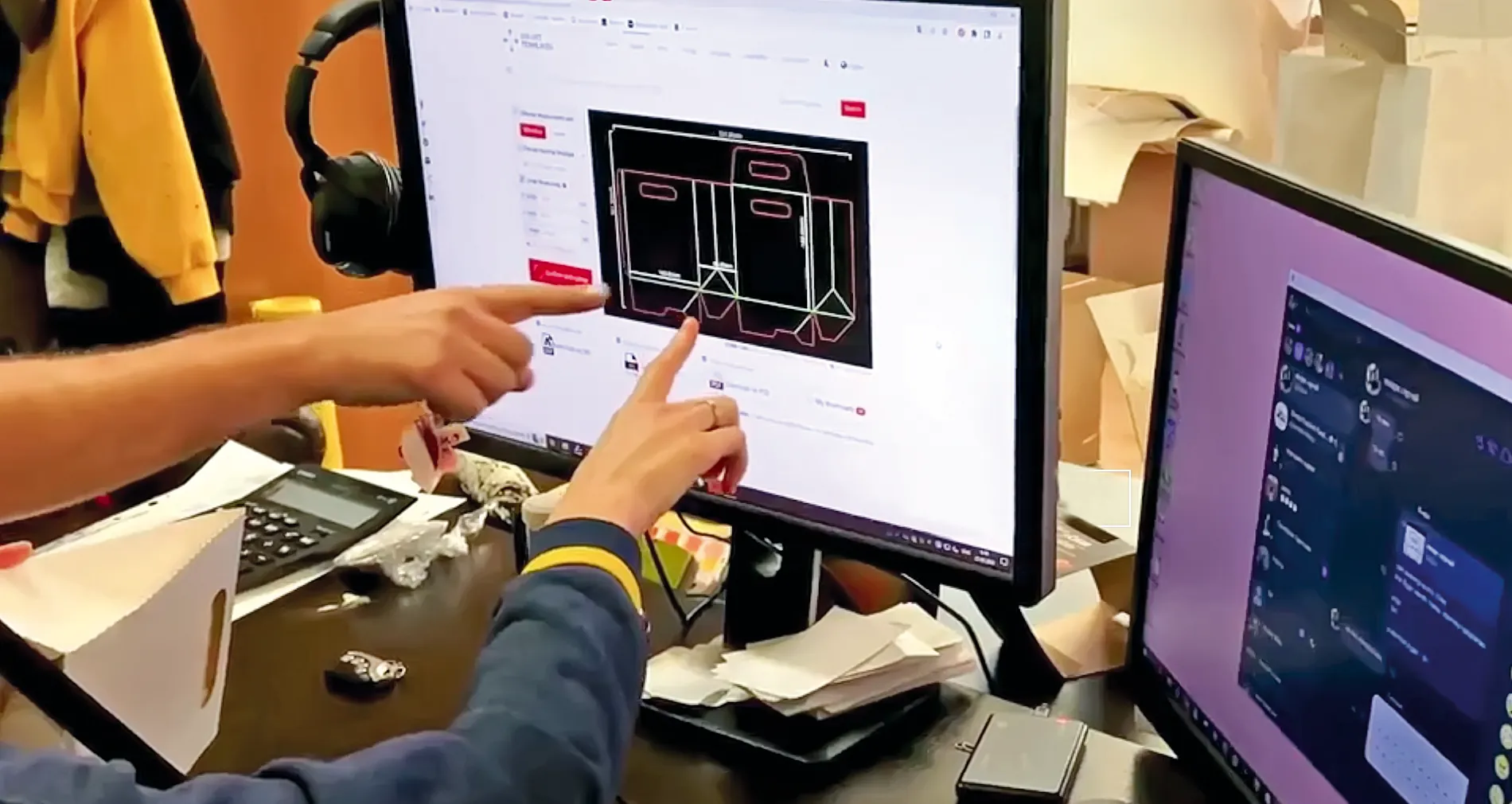
A box prototype at the Pergament printing house in Chisinau is made from 30 minutes. The engineer builds the dieline in CAD, and the cutting plotter cuts the sample. And there you are, turning your future packaging over in your hands before the run is even ordered: fit your product and approve the dimensions before the cutting die is made and the run starts.
How a box prototype is made: the CAD dieline and the cutting plotter
1. Describe the task. What the product is, what size, what quantity — tell us by phone, by email or at our office. If you can bring the product itself, we design the box around it from the start.
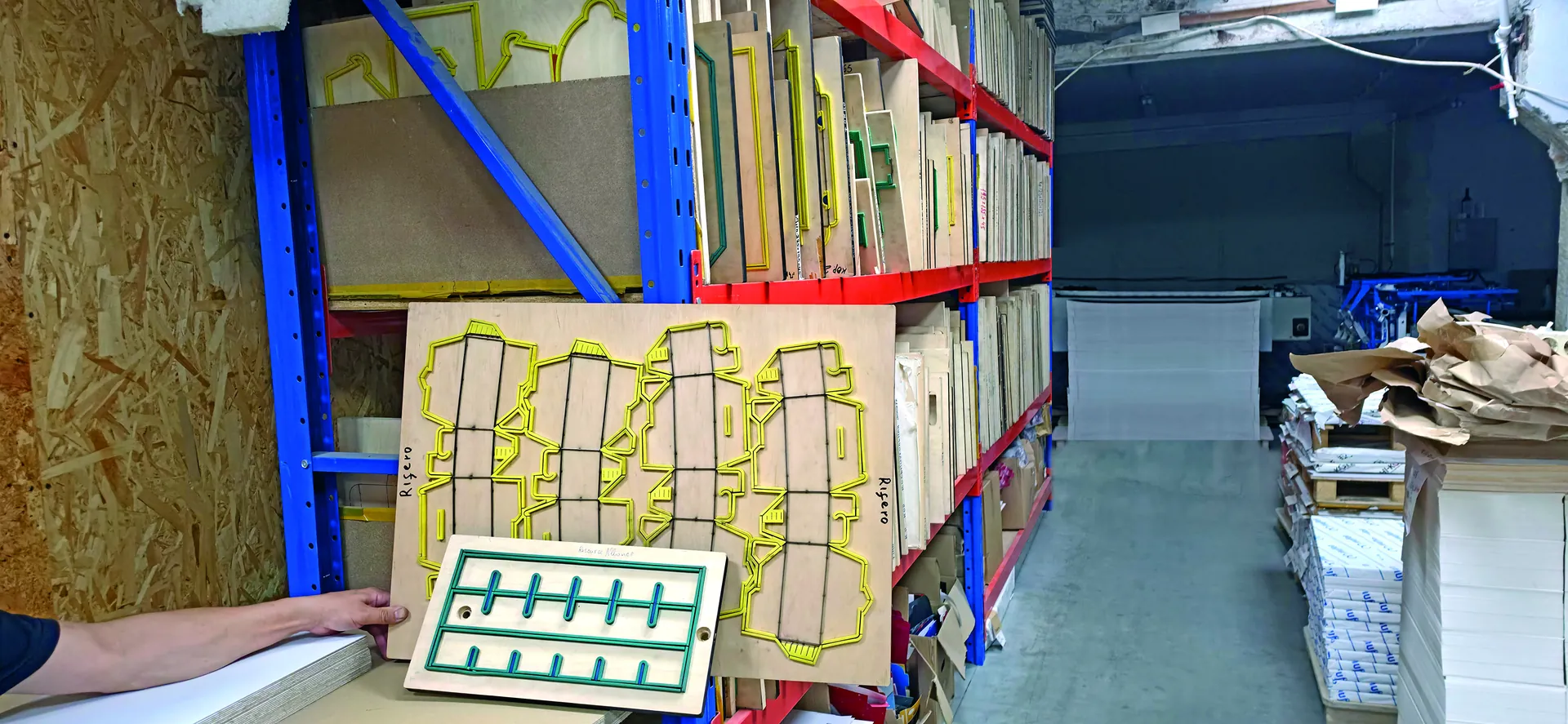
2. The engineer builds the dieline in CAD. The geometry is worked out in advance, so the assembled box closes properly the first time. Often a suitable shape is already in our library — it holds over 3,000 ready-made cutting dies — and then you save on the die. If not, we design the structure from scratch.
3. The plotter cuts the sample. From 30 minutes — and the prototype is ready: the knife head cuts along the contour, the creasing wheel scores the fold lines — no cutting die. Assemble the sample and try it with your product — you see at once whether the structure fits or needs adjusting.
4. Need a sample with your design — we print a colour test mini-run. That is the job of our press-class digital department; its samples are almost indistinguishable from the production run. Take it to management or photograph it for a presentation.
Lead times and costs: from prototype to production run
The usual client path: prototype → pilot batch → production run on offset. What you get at each step, how long it takes and what we need from you:
| What you get | Lead time | Price | What we need from you |
|---|---|---|---|
| Unprinted structural sample: CAD dieline, cutting and creasing on the plotter | from 30 minutes | simple structure — €100, complex — €200; if you order the run within 60 days, the amount is credited towards the order | product description, dimensions, quantity; ideally the product itself |
| Printed sample: a colour test mini-run on the digital press | in 1–2 days, with no plates and no die | on quotation | approved structure and artwork in PDF |
| Pilot batch: a small digital run with plotter cutting | in 1–2 days | on quotation | approved sample and artwork |
| Production run of cardboard packaging | 100–1,000 pcs — 2–5 working days, 1,000 pcs and above — by production schedule; food packaging and HoReCa — from 500 pcs, 3–5 days (smaller quantities — on quotation) | per the price ranges in the box printing cost article | approved prototype and artwork |
| Production run of rigid boxes (lid and base) | from 30 pcs — 7–15 days | guide prices — on the rigid boxes page | approved prototype and artwork |
Lead times are typical: faster with a ready cutting die, and they can grow in high season.
How much sample development costs
A sample of a simple structure — €100, of a complex one — €200 (non-standard geometry, multi-part boxes, inserts). Payment in MDL at the NBM exchange rate.
If you order the run within 60 days, the development cost is credited towards the order. So for those who go into production, the prototype ends up costing nothing.
What you get
- A physical sample of exact dimensions — fill it with your product or put it on the shelf next to the competition.
- A proven structure: a geometry error shows up on the sample, while fixing it still costs pennies.
- A ready base for the run: the approved prototype goes into production, the order’s tech passport is stored in the production system, and a repeat run comes out identical to the first.
- A price and lead-time calculation before launch — operation by operation, with several material and finishing options on request.
How to order a box prototype
1. Send what you have. The dimensions of the future box, or simply a sample of the goods that need packaging; the quantity — ideally two or three options at once; the purpose — especially whether there will be food contact.
2. Send the task however suits you. By phone, by email or at a meeting in our office — the contacts are at the end of the page.
3. Collect the sample. From 30 minutes — and the structure is cut; we hand it over however suits you.
4. Approve the sample — and we cost the run. From the approved prototype we calculate the price and lead time operation by operation, in 2–3 variants from the start: a different quantity, a different board, with or without lamination. Prepare the print artwork to our artwork requirements; how the order proceeds is described in the order process.
Questions and answers
Do I need to come in person?
No — describe the task by phone or email, and we hand over the sample however suits you. A meeting is faster though: the engineer clarifies the details on the spot, and you see the production floor too.
Will the prototype be printed?
A plotter sample is the structure without printing. If you need a sample with your design, we print a colour test mini-run in the digital department — very close to the production item in quality, and ready in 1–2 days, with no plates and no die.
What if the structure does not fit?
We adjust the dieline and cut a new sample. At this stage changing the structure is easy and inexpensive — that is exactly what the prototype is for.
Do I have to order a print run afterwards?
No, sample development is a stand-alone service with no obligations. If a run is ordered within 60 days after all, you effectively pay nothing for the sample.
Do I need finished artwork to make a prototype?
No. The plotter cuts the structure without printing, so the dimensions or the product itself and the quantity are enough — we propose the structure and the sheet layout. Artwork is needed for a printed sample and for the run; the file requirements are on the Artwork requirements page.
What happens after the prototype is approved?
We cost the run operation by operation, and the approved prototype goes into production: the order’s tech passport is stored in the production system. Typical lead times are in the “Lead times and costs” table and on the Order process page; faster with a ready cutting die.
See also
- Order process: from inquiry to dispatch
- How much box printing costs: price ranges from real orders
- Minimum order quantity and lead times
- Artwork requirements
- Frequently asked questions
- Cardboard packaging
- Cardboard packaging for food and HoReCa
- Rigid boxes (lid and base) on greyboard
- VIP boxes for cosmetics
- Case study: boxes for a confectionery chain
- Case study: cosmetics packaging
- Case study: a wine gift box
- Production and technology
Order a prototype
Call or write: +373 79 044 417 (Viber, Telegram) · contact@pergament.md. Better still, come and see us: Chisinau, 170 Columna St., block C — we will discuss the task and show you the production floor. How the cutting plotter cuts a dieline — in the video on this page.